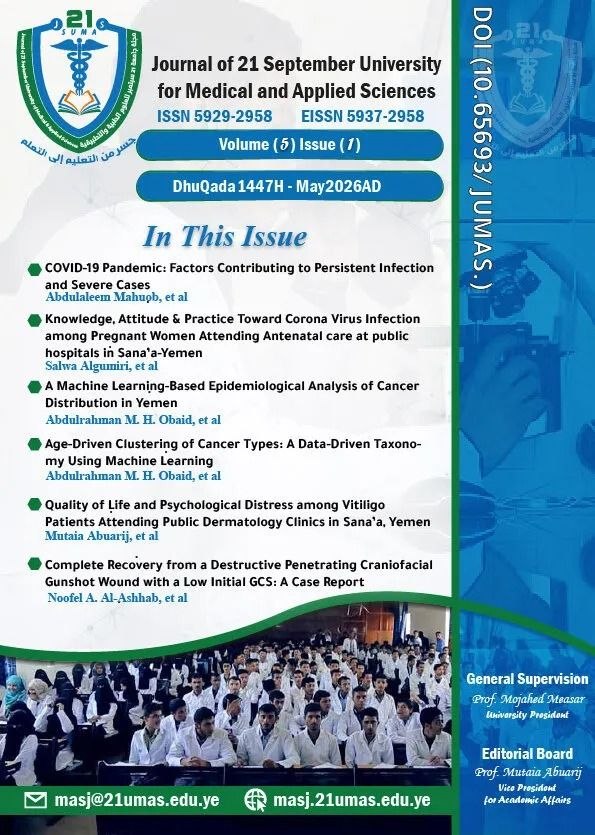
COVID-19 Pandemic: Factors Contributing to Persistent Infection and Severe Cases
DOI:
https://doi.org/10.65693/j21umas.2026.v5i1.369Keywords:
COVID-19, Pandemic, COVID-19, Infection, Severe casesAbstract
Presently it is an era of viral foes against humanity. No one could expect the breakout of a new viral epidemic unless we make efforts to investigate new viruses in the wildlife and wet meats of exotic animals. Despite the prolonged duration of lockdown to control the transmission and the recovery of infected patients with SARS-CoV-2 virus, there are many new cases and deaths. Reviewing the literature provides the rationale behind daily reported new cases and deaths. Incomplete clearance of the virus new mutated genomic variants or a lack of immunisation against the virus could lead to re-infection or persistent infection. The severity of COVID-19 could be due to co-infection with other pathogens, chronic infections, nosocomial infections, highly virulent variants of the virus, or highly upregulated angiotensin-renin converting enzyme receptors II (ACE-II) in patients who have a history of hypertension, chronic chest infections or diabetes. Even after the lockdown is over, we should maintain good personal hygiene, physical distancing, wear face mask and gloves. Developing a safe and effective vaccine and antiviral agents could control the transmission and epidemic of SARS-CoV-2 virus.
References
1.Organisation WH. Infectious diseases. https://www.emro.who.int/health-topics/infectious-diseases/ .
2. Morse SS. Factors in the emergence of infectious diseases. Plagues and politics: Springer; 2001:8-26.
3. Stein RA. Super-spreaders in infectious diseases. International Journal of Infectious Diseases 2011;15:e510-e3.
4. Barker J, Stevens D, Bloomfield S. Spread and prevention of some common viral infections in community facilities and domestic homes. Journal of Applied Microbiology 2001;91:7-21.
5. Holmes KK, Bertozzi S, Bloom BR, et al. Major Infectious Diseases: Key Messages from Disease Control Priorities,. In: King K Holmes, Stefano Bertozzi, Barry R Bloom, et al., eds. Major Infectious Diseases. 3rd ed. Washington (DC): The International Bank for Reconstruction and Development / The World Bank; 2017 3 November. Chapter 1.
6. Zhou P, Yang X-L, Wang X-G, et al. A pneumonia outbreak associated with a new coronavirus of probable bat origin. Nature 2020;579:270-3.
7. Zhang T, Wu Q, Zhang Z. Probable Pangolin Origin of SARS-CoV-2 Associated with the COVID-19 Outbreak. Current Biology 2020;30:1346-51.e2.
8. Chen T-M, Rui J, Wang Q-P, Zhao Z-Y, Cui J-A, Yin L. A mathematical model for simulating the phase-based transmissibility of a novel coronavirus. Infectious diseases of poverty 2020;9:1-8.
9. Koyama T, Platt D, Parida L. Variant analysis of COVID-19 genomes. Bull World Health Organ. 2020 Jul 1;98(7):495-504.
10. Organisation WH. Coronavirus disease (COVID-19); Situation Report – 104. Data as received by WHO from national authorities by 10:00 CEST, 3 May 2020. chrome-extension://efaidnbmnnnibpcajpcglclefindmkaj/https://www.who.int/docs/default-source/coronaviruse/situation-reports/20200503-covid-19-sitrep-104.pdf.
11. Pal C, Manczinger M, Berces A. How genetic variation in the immune system predicts COVID-19 disease outcome. 2020.
12. Liu P, Chen W, Chen J-P. Viral Metagenomics Revealed Sendai Virus and Coronavirus Infection of Malayan Pangolins (Manis javanica). Viruses 2019;11:979.
13. Du M, Cai G, Chen F, Christiani DC, Zhang Z, Wang M. Multi-omics Evaluation of Gastrointestinal and Other Clinical Characteristics of SARS-CoV-2 and COVID-19. Gastroenterology. 2020 Jun;158(8):2298-2301.
14. Ding S, Liang TJ. Is SARS-CoV-2 Also an Enteric Pathogen with Potential Fecal-Oral Transmission: A COVID-19 Virological and Clinical Review. Gastroenterology. 2020 Jul;159(1):53-61..
15. Prompetchara E, Ketloy C, Palaga T. Immune responses in COVID-19 and potential vaccines: Lessons learned from SARS and MERS epidemic. Asian Pac J Allergy Immunol 2020;38:1-9.
16. Park M, Cook AR, Lim JT, Sun Y, Dickens BL. A systematic review of COVID-19 epidemiology based on current evidence. Journal of Clinical Medicine 2020;9:967.
17. Klompas M. Coronavirus Disease 2019 (COVID-19): Protecting hospitals from the invisible. Annals of internal medicine. Volume 172, Number 9/2020.
18. Bao L, Deng W, Gao H, et al. Re-infection could not occur in SARS-CoV-2 infected rhesus macaques. bioRxiv preprint doi: https://doi.org/10.1101/2020.03.13.990226; this version posted March 14, 2020.
19. Stafford N. Covid-19: Why Germany’s case fatality rate seems so low. BMJ 2020;369.
20. Kellam P, Barclay W. The Dynamics of Humoral Immune Responses Following SARS-CoV-2 Infection and the Potential for Re-infection. J Gen Virol. 2020 Aug;101(8):791-797.
21. Omer SB, Malani P, Del Rio C. The COVID-19 Pandemic in the US: A Clinical Update. JAMA. 2020;323;(18):1767-1768.
22. Alizargar J. Risk of reactivation or re-infection of novel coronavirus (COVID-19). J Formos Med Assoc. 2020 Apr 23;119(6):1123.
23. Wang M, Hu Z, Liu J, et al. Positive RT-PCR Test Results in Discharged COVID-19 Patients: Re-infection or Residual? 2020. chrome-extension://efaidnbmnnnibpcajpcglclefindmkaj/https://assets-eu.researchsquare.com/files/rs-18042/v1/4a7aeedb-ade4-44b6-bba3-f1725ed77001.pdf?c=1631832001
24. Zheng KI, Wang X-B, Jin X-H, et al. A Case Series of Recurrent Viral RNA Positivity in Recovered COVID-19 Chinese Patients.
J Gen Intern Med. 2020 Jul;35(7):2205-2206.
25. Luo A. Positive SARS-Cov-2 test in a woman with COVID-19 at 22 days after hospital discharge: A case report. Journal of Traditional Chinese Medical Sciences. Volume 7, Issue 4, December 2020, Pages 413-417
26. Yuan J, Kou S, Liang Y, Zeng J, Pan Y, Liu L. Clinical Characteristics on 25 Discharged Patients with COVID-19 Virus Returning. medRxiv preprint doi: https://doi.org/10.1101/2020.03.06.20031377 ; this version posted March 10, 2020.
27. Lan L, Xu D, Ye G, et al. Positive RT-PCR test results in patients recovered from COVID-19. Jama. 2020 Apr 21;323(15):1502-1503.
28. Mahase E. Covid-19: WHO and South Korea investigate reconfirmed cases. British Medical Journal Publishing Group; 2020.
29. Hu E. COVID-19 Testing: Challenges, Limitations and Suggestions for Improvement. Preprints (www.preprints.org) | NOT PEER-REVIEWED | Posted: 9 April 2020 .
30. Winter AK, Hegde ST. The important role of serology for COVID-19 control. Lancet Infect Dis. 2020 Jul;20(7):758-759.
31. Zhou P, Liu Z, Chen Y, Xiao Y, Huang X, Fan X-G. Bacterial and fungal infections in COVID-19 patients: A matter of concern. Infection Control & Hospital Epidemiology 2020:1-7.
32. Khodamoradi Z, Moghadami M, Lotfi M. Co-infection of coronavirus disease 2019 and influenza: a report from Iran. Arch Iran Med. 2020 Apr 1;23(4):239-243.
33. Chen T, Song J, Liu H, Zheng H, Chen C. Positive Epstein-Barr Virus Detection in Corona Virus Disease 2019 (COVID-19) Patients. Sci Rep. 2021 May 25;11(1):10902..
34. Chaung J, Chan D, Pada S, Tambyah PA. Co-infection with COVID-19 and Coronavirus HKU1 – the critical need for repeat testing if clinically indicated. J Med Virol. 2020 Oct;92(10):1785-1786.
35. Cox MJ, Loman N, Bogaert D, O'Grady J. Co-infections: potentially lethal and unexplored in COVID-19. Lancet Microbe. 2020 May;1(1):e11.
36. Wang J, Tang Y, Ma Y, et al. Efficacy and Safety of Antibiotic Agents in Children with COVID-19: A Rapid Review. Ann Transl Med. 2020 May;8(10):619.
37. Blasco ML, Buesa J, Colomina J, et al. Co-detection of respiratory pathogens in patients hospitalised with Coronavirus viral disease-2019 pneumonia. J Med Virol. 2020 Oct;92(10):1799-1801.
38. Xing Q, Li G-j, Xing Y-h, et al. Precautions are needed for COVID-19 patients with co-infection of common respiratory pathogens. medRxiv preprint doi: https://doi.org/10.1101/2020.02.29.20027698 ; this version posted March 5, 2020.
39. Ou X, Zhou L, Huang H, Lin Y, Pan X, Chen D. A severe case with co-infection of SARS-CoV-2 and common respiratory pathogens.
Travel Med Infect Dis. 2020 May-Jun:35:101672.
40. Liu L, Lei X, Xiao X, et al. Epidemiological and Clinical Characteristics of COVID-19 Patients in Shiyan City of Hubei Province, China. 2020.
41. Arashiro T, Nakamura S, Asami T, et al. SARS-CoV-2 and Legionella Co-infection in a Person Returning from a Nile Cruise.
J Travel Med. 2020 May 18;27(3):taaa053.
42. Zhang G, Hu C, Luo L, et al. Clinical features and short-term outcomes of 221 patients with COVID-19 in Wuhan, China. J Clin Virol. 2020 Jun:127:104364.
43. Claire D, Rémi Le G, Claire T, et al. Panton-Valentine Leukocidin–Secreting Staphylococcus aureus Pneumonia Complicating COVID-19. Emerg Infect Dis. 2020 Aug;26(8):1939-1941.
44. Shupeng J, Panpan L, Ge X, et al. Co-infection of SARS-CoV-2 and multiple respiratory pathogens in children. Clin Chem Lab Med. 2020 Jun 25;58(7):1160-1161.
45. Ofstead CL, Hopkins KM, Binnicker MJ, Poland GA. Potential impact of contaminated bronchoscopes on novel coronavirus disease (COVID-19) patients. Infection Control & Hospital Epidemiology 2020:1-10.
46. Boffa J, Mhlaba T, Sulis G, et al. COVID-19 and tuberculosis in South Africa: A dangerous combination. SAMJ: South African Medical Journal 2020;110:1-2.
47. Bogorodckaya E, Sinitsyn M, Borisov S, Belilovskiy E. Collaboration in TB and COVID-19 control in Moscow. http://dx.doi.org/10.5588/ijtld.20.0223
48. Liu Y, Bi L, Chen Y, et al. Active or latent tuberculosis increases susceptibility to COVID-19 and disease severity. medRxiv 2020:2020.03.10.20033795.
49. Ding Q, Lu P, Fan Y, Xia Y, Liu M. The clinical characteristics of pneumonia patients coinfected with 2019 novel coronavirus and influenza virus in Wuhan, China. J Med Virol. 2020 Sep;92(9):1549-1555.
50.Wu X, Cai Y, Huang X, et al. Co-infection with SARS-CoV-2 and Influenza A Virus in Patient with Pneumonia, China. Emerg Infect Dis 2020;26.
51.Rodriguez JA, Rubio-Gomez H, Roa AA, Miller N, Eckardt PA. Co-Infection with SARS-COV-2 and Parainfluenza in a young adult patient with pneumonia: Case Report. IDCases 2020;20:e00762.
52. Danis K, Epaulard O, Bénet T, et al. Cluster of coronavirus disease 2019 (Covid-19) in the French Alps, February 2020. Clin Infect Dis. 2020 Jul 28;71(15):825-832.
53. Fan BE, Lim KGE, Chong VCL, Chan SSW, Ong KH, Kuperan P. COVID-19 and mycoplasma pneumoniae co-infection. Am J Hematol. 2020 Jun;95(6):723-724.
54. Shiau S, Krause KD, Valera P, Swaminathan S, Halkitis PN. The Burden of COVID-19 in People Living with HIV: A Syndemic Perspective. AIDS and Behavior 2020:1-6.
55. Wang M, Luo L, Bu H, Xia H. Case Report: One Case of Coronavirus Desease 2019(COVID-19) in Patient Co-nfected by HIV With a Low CD4+ T Cell Count. Int J Infect Dis. 2020 Jul:96:148-150.56.
56. Lippi G, Plebani M. Procalcitonin in patients with severe coronavirus disease 2019 (COVID-19): A meta-analysis. Clin Chim Acta 2020;505:190-1.
57. Saavedra-Velasco M, Chiara-Chilet C, Pichardo-Rodriguez R, Grandez-Urbina A, Inga-Berrospi F. Coinfection between dengue and covid-19: need for approach in endemic zones. Revista de la Facultad de Ciencias Medicas (Cordoba, Argentina) 2020;77:52-4.
58. Chen G, Wu D, Guo W, et al. Clinical and immunologic features in severe and moderate Coronavirus Disease 2019.
J Clin Invest. 2020 May 1;130(5):2620-2629.
59. Qin C, Zhou L, Hu Z, et al. Dysregulation of immune response in patients with COVID-19 in Wuhan, China. Clin Infect Dis. 2020 Mar 12:ciaa248.
60.Li X, Geng M, Peng Y, Meng L, Lu S. Molecular immune pathogenesis and diagnosis of COVID-19. Journal of Pharmaceutical Analysis 2020;10:102-8.
61.Wu D, Yang XO. TH17 responses in cytokine storm of COVID-19: An emerging target of JAK2 inhibitor Fedratinib. J Microbiol Immunol Infect. 2020 Jun;53(3):368-370.
62. Pedersen SF, Ho Y-C. SARS-CoV-2: a storm is raging. J Clin Invest. 2020 May 1;130(5):2202-2205.
63. Huang C, Wang Y, Li X, et al. Clinical features of patients infected with 2019 novel coronavirus in Wuhan, China. The Lancet 2020;395:497-506.
64. Thevarajan I, Nguyen TH, Koutsakos M, et al. Breadth of concomitant immune responses prior to patient recovery: a case report of non-severe COVID-19. Nature Medicine 2020;26:453-5.
65. Brake SJ, Barnsley K, Lu W, McAlinden KD, Eapen MS, Sohal SS. Smoking upregulates angiotensin-converting enzyme-2 receptor: a potential adhesion site for novel coronavirus SARS-CoV-2 (Covid-19).
J Clin Med. 2020 Mar 20;9(3):841.
66. Singh AK, Gupta R, Ghosh A, Misra A. Diabetes in COVID-19: Prevalence, pathophysiology, prognosis and practical considerations. Diabetes Metab Syndr. 2020 Jul-Aug;14(4):303-310.
67. Singh AK, Gupta R, Misra A. Comorbidities in COVID-19: Outcomes in hypertensive cohort and controversies with renin angiotensin system blockers. Diabetes Metab Syndr. 2020 Jul-Aug;14(4):283-287.
68. Pinto BG, Oliveira AE, Singh Y, et al. ACE2 Expression is Increased in the Lungs of Patients with Comorbidities Associated with Severe COVID-19. J Infect Dis. 2020 Jul 23;222(4):556-563.
69. Wei X, Xiao Y-T, Wang J, et al. Sex Differences in Severity and Mortality Among Patients With COVID-19: Evidence from Pooled Literature Analysis and Insights from Integrated Bioinformatic Analysis. arXiv preprint arXiv:200313547 2020.
70. Feng Z, Li J, Yao S, et al. The Use of Adjuvant Therapy in Preventing Progression to Severe Pneumonia in Patients with Coronavirus Disease 2019: A Multicenter Data Analysis. medRxiv preprint doi: https://doi.org/10.1101/2020.04.08.20057539 ; (which was not certified by peer review) this version posted April 10, 2020.
71. Forster P, Forster L, Renfrew C, Forster M. Phylogenetic network analysis of SARS-CoV-2 genomes. Contributed by Colin Renfrew, March 30, 2020 (sent for review March 17, 2020; reviewed by Toomas Kivisild and Carol Stocking).
72. Woo PC, Huang Y, Lau SK, Yuen K-Y. Coronavirus genomics and bioinformatics analysis. viruses 2010;2:1804-20.
73. Auewarakul P. Composition bias and genome polarity of RNA viruses. Virus Res 2005;109:33-7.
74. Smieszek S, Przychodzen B, Polymeropoulos MH. Amantadine disrupts lysosomal gene expression; potential therapy for COVID19. bioRxiv preprint doi: https://doi.org/10.1101/2020.04.05.026187 ; this version posted April 5, 2020.
75. Mori T, Nakamura K, Masaoka K, et al. Cleavage of influenza RNA by using a human PUF-based artificial RNA-binding protein–staphylococcal nuclease hybrid. Biochemical and Biophysical Research Communications 2016;479:736-40.
76. Garstka MA, Neefjes J. How to target MHC class II into the MIIC compartment. Molecular Immunology 2013;55:162-5.
77. van Kasteren SI, Overkleeft H, Ovaa H, Neefjes J. Chemical biology of antigen presentation by MHC molecules. Current Opinion in Immunology 2014;26:21-31.
5. Al-Wesabi, M., & Shamlan, M. (2022). The Effect of Applying Infection Prevention and Control Standards in Sana’a Governorate Hospitals at the Level of Reducing the Spread of Diseases and Epidemics. Journal of 21 September University for Medical and Applied Sciences, 1(1). https://doi.org/10.65693/masj.2022.v1i1.17
6. Alyahawi, A., Al-Wesabi, M., & ALKaf, A. (2022). Antimicrobial susceptibility of Acinetobacter clinical isolates among ICU Patients in Sana’a City, Yemen. Journal of 21 September University for Medical and Applied Sciences, 1(1). https://doi.org/10.65693/masj.2022.v1i1.14
7. Alyahawi A, Measar M, Alwesabi M, Alkaf A. (2024). Clinically Significant Statin-Drug Interactions in Older Patients with Chronic Diseases. Pharmaceutical Research - Recent Advances and Trends Vol. 4, B P International, pp.1-21. https://doi.org/10.9734/bpi/prrat/v4/598
Me’asar, M., Al-Hoothi, E., Shamsaldin, M., & Al-Shahethi, A. (2025). Clinical Presentation Variants of Chronic Subdural Hematoma Cases. Journal of 21 September University for Medical and Applied Sciences, 4(1). https://doi.org/10.65693/j21umas.2025.v4i1.217
Al-Akhali, K., & Alyahawi, A. (2025). The Role of Clinical Pharmacists in the Detection and Evaluation of Adverse Drug Events: A Review Article. Journal of 21 September University for Medical and Applied Sciences, 4(1). https://doi.org/10.65693/j21umas.2025.v4i1.220
Shamsaldin, M., Mojahed Me'asar, M. M., Ghanem, A., & Al-Aswadi, A. (2025). Epidemiological Description of Primary Brain Tumors: A Single-Center Retrospective Study of 75 Cases, Yemen. Journal of 21 September University for Medical and Applied Sciences, 4(1). https://doi.org/10.65693/j21umas.2025.v4i1.218
Abuarij, M., & Al-Agbari, A. (2024). Epidemiological Situation of Mucocutaneous Leishmaniasis in Yemen: A Descriptive Study in the Period from January 2017 to December 2022. Journal of 21 September University for Medical and Applied Sciences, 3(1), 1-11. https://doi.org/10.65693/j21umas.2024.v3i1.200
Abuarij, M., & Al Qtwani, A. (2023). Efficacy of Oral Isotretinoin in Combination with Desloratadine in the Treatment of Acne Vulgaris at Al-Thawrah General Hospital, Sana’a, Yemen . Journal of 21 September University for Medical and Applied Sciences, 2(1), 17-30. https://doi.org/10.65693/masj.2023.v2i1.23
13. Qabban, K. A., Al-Wesabi, M. M. (2025). The Impact of Career Development on Improving Nursing Performance in Yemen Hospitals - Sana’a. Sana’a University Journal of Human Sciences, 4(11), 277-317. https://doi.org/10.59628/jhs.v4i11.1809
Downloads
Published
Issue
Section
License
Copyright (c) 2026 Abdulaleem Mahuob، Khaled Alkhali، Lyna Irawati (المؤلف)

This work is licensed under a Creative Commons Attribution 4.0 International License.
This is an open-access journal which means that all content is freely available without charge to the user or their institution. Users are allowed to read, download, copy, distribute, print, search, or link to the full texts of the articles, or use them for any other lawful purpose, provided the original work is properly cited. All articles are licensed under a Creative Commons Attribution 4.0 International License (CC BY 4.0).