
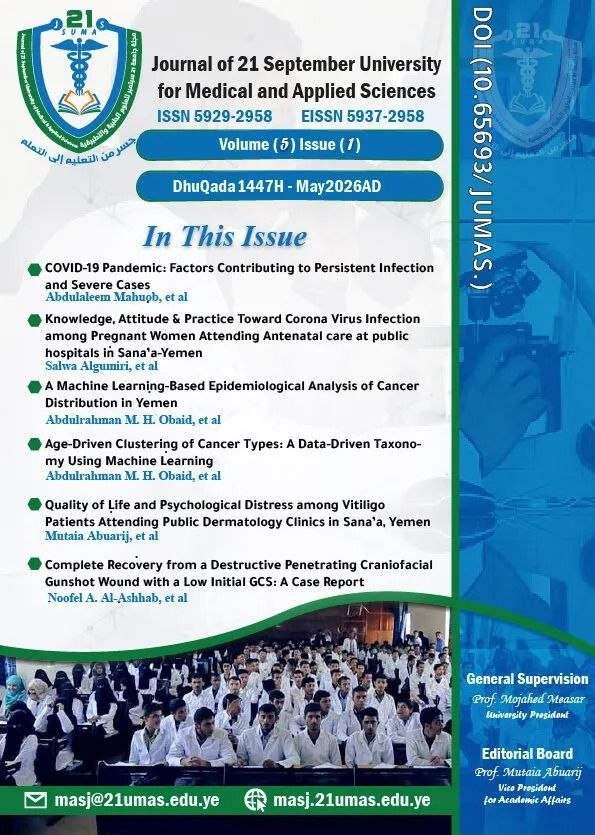
Complete Recovery from a Destructive Penetrating Craniofacial Gunshot Wound with a Low Initial GCS: A Case Report
DOI:
https://doi.org/10.65693/j21umas.2026.v5i1.421الكلمات المفتاحية:
CranioPenetrating brain injury; Craniofacial gunshot wound; Glasgow Coma Scale; Prognosis; Multidisciplinary surgeryالملخص
Background: Penetrating craniofacial gunshot wounds (GSWs) are among the most lethal forms of traumatic brain injury (TBI). Civilian survival rates are frequently below 15%, and mortality rates approach 80–98% in patients presenting with a Glasgow Coma Scale (GCS) score ≤5. Although admission GCS is the strongest predictor of outcome, limited cases of meaningful recovery suggest that prognosis should not rely on GCS alone.
Case Presentation:A 25-year-old man presented one hour after a self-inflicted point-blank craniofacial gunshot wound. On arrival, he was hypotensive (80/50 mmHg), hypoxic (SpO₂ ~60%), and comatose with GCS 5 (E1V1M3). Examination revealed a large destructive left craniofacial wound with exposed brain tissue, a ruptured left globe, decorticate posturing, and a fixed dilated right pupil. After aggressive resuscitation and stabilization, computed tomography demonstrated extensive comminuted craniofacial fractures, a large left frontal bone defect, and unilateral frontal lobe contusions without ventricular violation or a transhemispheric trajectory. Emergent multidisciplinary surgery included extensive debridement, removal of bone and foreign fragments, hemostasis, duraplasty using fascia lata graft, and staged facial reconstruction. Postoperatively, the patient demonstrated rapid neurological improvement. By postoperative day 7, he was fully conscious, oriented, and neurologically intact except for left monocular blindness. A transient cerebrospinal fluid (CSF) leak resolved with conservative therapy. At 12 months, he exhibited normal speech, intact motor function, and stable cognitive recovery.
Conclusion: Extremely low admission GCS should not automatically preclude aggressive intervention in penetrating brain injury. Injury trajectory, ventricular involvement, rapid correction of secondary insults, and coordinated multidisciplinary management critically influence outcome. Carefully selected patients may achieve meaningful recovery despite traditionally grave prognostic indicators.
المراجع
1. Menezes JM, Batra K, Zhitny VP. A nationwide analysis of gunshot wounds of the head and neck: morbidity, mortality, and cost. J Craniofac Surg. 2023;34(6):1655–1660. doi:10.1097/SCS.0000000000009268.
2. Marhold F, Scheichel F, Ladisich B, et al. Surviving the scene in civilian penetrating brain injury: injury type, cause and outcome in a consecutive patient series in Austria. Front Surg. 2022;9:923949.
3. Kohpe Kapseu S, Esseme Ndjie CH, Tchokonte-Nana V. A successful initial management of a penetrating head trauma in a rural district hospital: case report. Trauma Case Rep. 2025;55:101128. doi:10.1016/j.tcr.2025.101128
4. Frösen J, Frisk O, Raj R, Hernesniemi J, Tukiainen E, Barner-Rasmussen I. Outcome and rational management of civilian gunshot injuries to the brain-retrospective analysis of patients treated at the Helsinki University Hospital from 2000 to 2012. Acta Neurochir (Wien). 2019;161(7):1285-1295. doi:10.1007/s00701-019-03952-y
5.Lilford RD, Hossain I, Dahlberg M, et al. Increased Incidence and Mortality of Civilian Penetrating Traumatic Brain Injury in Sweden: A Single-Center Registry-Based Study. World Neurosurg. 2024;182:e493-e505. doi:10.1016/j.wneu.2023.11.129
6. Śmiłowska K, Pytel J, Krawczyk L, Śmiłowski M, Jałowiecki P. Penetrating brain injury: a case report. Anaesthesiol Intensive Ther. 2015;47(3):214-218. doi:10.5603/AIT.2015.0035.
7. Maragkos GA, Papavassiliou E, Stippler M, Filippidis AS. Civilian Gunshot Wounds to the Head: Prognostic Factors Affecting Mortality: Meta-Analysis of 1774 Patients. J Neurotrauma. 2018;35(22):2605-2614. doi:10.1089/neu.2018.5682.
8. Alvis-Miranda HR, M Rubiano A, Agrawal A, et al. Craniocerebral Gunshot Injuries; A Review of the Current Literature. Bull Emerg Trauma. 2016;4(2):65-74.
9. Spaite DW, Hu C, Bobrow BJ, et al. The Effect of Combined Out-of-Hospital Hypotension and Hypoxia on Mortality in Major Traumatic Brain Injury. Ann Emerg Med. 2017;69(1):62-72. doi:10.1016/j.annemergmed.2016.08.007.
10. Joseph B, Aziz H, Pandit V, et al. Improving survival rates after civilian gunshot wounds to the brain. J Am Coll Surg. 2014;218(1):58-65. doi:10.1016/j.jamcollsurg.2013.08.018.
11. Mansour A, Powla PP, Alvarado-Dyer R, et al. Comparative Analysis of Clinical Severity and Outcomes in Penetrating Versus Blunt Traumatic Brain Injury Propensity Matched Cohorts. Neurotrauma Rep. 2024;5(1):348-358. Published 2024 Apr 3. doi:10.1089/neur.2024.0009.
12. Zuniga RDDR, Vieira RCA, Solla DJF, et al. Long-term outcome of traumatic brain injury patients with initial GCS of 3-5. World Neurosurg X. 2024;23:100361. Published 2024 Mar 8. doi:10.1016/j.wnsx.2024.100361
13. Reyes G, Gadot R, Ouellette L, Nouri SH, Gopinath SP, Patel AJ. Firearm-Related Traumatic Brain Injuries in Adults: A Scoping Review. Neurosurgery. 2024;94(2):229-239. doi:10.1227/neu.0000000000002734.
14. Schwartz B, Troy C, Dugan JE, Pernik MN, Wallace DA, Venable GT, et al. 1111 Aggressive surgical intervention for penetrating gunshot wounds to the head: the experience of a high-volume trauma center. Neurosurgery. 2025;71(Suppl 1):165. doi:10.1227/neu.0000000000003360_1111.
15. Qi H, Li K. Civilian gunshot wounds to the head: a case report, clinical management, and literature review. Chin Neurosurg J. 2021;7(1):12. Published 2021 Feb 3. doi:10.1186/s41016-020-00227-9.
16. Reddy HR, Bay COA, Layne SA, Williams M, Fossett D. A case of complete recovery from a transcranial bihemispheric civilian gunshot wound: a case report. J Case Rep Images Surg. 2021;7:100092Z12HR2021.
17. Gopakumar S, Anand A, McDonald MF, Karas PJ, Cruz Navarro J, Gopinath S. Prognostication of civilian gunshot wounds to the head: the Baylor score. J Neurosurg. Published online December 26, 2025. doi:10.3171/2025.8.JNS25168.
1. Alsalit, G.M., Al-Wesabi, M.M. & Jowah, H.M. Drivers of perceived healthcare service quality among healthcare workers in TQM-implementing hospitals in conflict-affected yemen: a cross-sectional study. Confl Health (2026). https://doi.org/10.1186/s13031-026-00839-5
2. Shamlan, M. A. M., & Al-Wesabi, M. M. M. (2026, May 26). Clinical governance and healthcare quality in conflict-affected settings: A cross-sectional study of hospitals in Yemen [Preprint]. Research Square. https://doi.org/10.21203/rs.3.rs-9442217/v1
3. Qabban, K. A., Al-Wesabi, M. M., & Jowah, H. M. (2026). Association between Joint Commission International patient-centered standards and self-reported nursing performance in Sana′a, Yemen hospitals. Journal of Nursing Management, 2026, Article 8353270. https://doi.org/10.1155/jonm/8353270
4. Al-Wesabi, M.M., Measar, M.A. & Eskander, N.A. Combined impact of surgical lighting and flooring surface characteristics on staff stress: A hospital field study. Sci Rep (2026). https://doi.org/10.1038/s41598-026-70738-5
التنزيلات
منشور
إصدار
القسم
الرخصة
الحقوق الفكرية (c) 2026 Noofel Al-Ashhab، Sakhr Alfaqih، Mohamed Shamsaldin، Abdulghani Al-Aswadi (المؤلف)

هذا العمل مرخص بموجب Creative Commons Attribution 4.0 International License.
تتبع هذه المجلة سياسة الوصول الحر (Open Access)، حيث تتوفر جميع محتوياتها مجاناً للمستخدمين والمؤسسات. يُسمح للقراء بتحميل الأبحاث، قراءتها، طباعتها، الاقتباس منها، أو البناء عليها، بشرط نَسب العمل إلى أصحابه الأصليين والإشارة إلى المجلة كمنصة للنشر. جميع المواد المنشورة تخضع لترخيص المشاع الإبداعي (نَسب المُصنَّف 4.0 دولي - CC BY 4.0).