
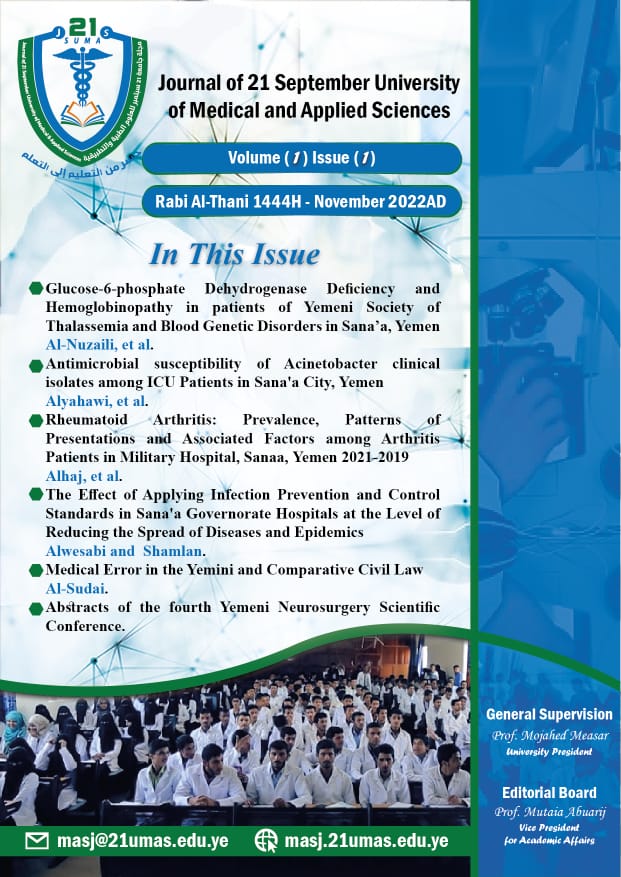
Glucose-6-phosphate Dehydrogenase Deficiency and Hemoglobinopathy among Patients of the Yemeni Society of Thalassemia and Blood Genetic Disorders in Sana’a, Yemen
DOI:
https://doi.org/10.65693/masj.2022.v1i1.11Keywords:
Glucose-6-phosphate Dehydrogenase (G6PD), Hemoglobinopathy, Sickle cell anemia (SCA), Sickle cell trait (SCT) and β-thalassemAbstract
Background: Glucose-6-phosphate dehydrogenase (G6PD) deficiency and hemoglobinopathies such as sickle cell anemia (SCA), sickle cell trait (SCT), and thalassemia are the most common congenital causes of hemolysis. The study aimed to determine the prevalence of G6PD deficiency in hemoglobinopathy patients and its effect on RBC indices.
Materials and methods: This case-descriptive study was carried out on a total of 100 hemoglobinopathy patients (51 males and 49 females) aged between 3 and 38 years. They attended the Yemeni Society for Thalassemia and Genetic Blood Disorders (YSTGBD) in Sana’a, Yemen, during the period between January and February 2021. Hb electrophoresis and/or HPLC methods were used to categorize them as sickle cell anemia (HbSS; n = 70), sickle cell trait (HbAS; n = 12), HbS/thalassemia major (n = 12), and HbS/thalassemia minor (n = 6). Five milliliters of venous-EDTA blood were collected from each patient and used to determine G6PD activity and the complete blood count (CBC). Data were analyzed using SPSS version 26 software.
Results: G6PD deficiency was detected in 29 (29.0%) of patients with hemoglobinopathy, of whom 16 (16.0%) were males and 13 (13.0%) were females. G6PD deficiency was discovered in 20 (20%), 3 (3%), 5%, and 1% of patients with HbSS, AS, S/β-thalassemia major, and minor hemoglobinopathies, respectively. In G6PD-deficient patients, G6PD activity significantly correlated positively with RBC (p= 0.048), MCH (p= 0.040), and MCHC (p= 0.002).
Conclusion: The prevalence of G6PD deficiency was high among hemoglobinopathy patients, particularly those with sickle cell anemia (SCA), which may contribute to a further increase in the hemolysis of RBCs. Therefore, screening hemoglobinopathy patients for G6PD levels is recommended during diagnosis and treatment.
References
References
1. Stanton RC. Glucose-6-phosphate dehydrogenase, NADPH, and cell survival. IUBMB Life. 2012; 64(5):362–369.
2. Au SW, Gover S, Lam VM, et al. Human glucose- 6-phosphate dehydrogenase: The crystal structure reveals a structural NADP+ molecule and provides insights into enzyme deficiency. Structure. 2000;8(3):293–303.
3. Eferth T, Schwarzl SM, Smith J, and Osieka R. Role of glucose-6-phosphate dehydrogenase for oxidative stress and apoptosis. Cell Death & Differentiation. 2006; 13(3):527-528.
4. Mason PJ, Bautista JM, Gilsanz F. G6PD deficiency: The genotype-phenotype association. Blood Rev. 2007;21:267–283.
5. Cappelini MD, Fiorelli G. Glucose-6-phosphate dehydrogenase deficiency. Lancet. 2008;371:64-74.
6. Nkhoma ET, Poole C, Vannappagari V, Hall SA, and Beutler E. The global prevalence of glucose-6-phosphate dehydrogenase deficiency: a systematic review and meta-analysis. Blood Cells Molecules and Diseases: 2009;42(3):267–278.
7. Mehta A, Mason PJ, and Vulliamy TJ. Glucose-6-phosphate dehydrogenase deficiency. Best Practice & Research: Clinical Haematology.2000;13(1):21–28.
8. Luzzatto L, Nannelli C, and Notaro R. Glucose-6-phosphate dehydrogenase deficiency. Hematology/Oncology Clinics of North America. 2016;30(2):373–393.
9. Ebong PE, Eyong EU, Bumah VV, Udoh EE. Effect of glucose-6-phosphate dehydrogenase activity and haemoglobin genotype on malaria parasite density in
Nigerian children. Niger J Biochem Mol Biol. 2009;24:38-41.
10. Rees DC, Williams TN, and Gladian MT. Sickle-cell disease. The Lancet. 2010;432-433
11. Yawn BP, Buchanan GR, Afenyi-Annan AN, et al. Management of sickle cell disease. Journal of the American Medical Association. 2014;312(10):1033-1048.
Yawn BP, Buchanan GR, Afenyi-Annan AN, et al. Management of sickle cell disease. Journal of the American Medical Association. 2014;312(10):1033-1048.
12. Lewis SM, Bain BJ, Bates I, Laffan MA. Dacie and Lewis Practical Haematology, Elseviers Int, Philadelphia, PA, USA, 2017, 12th edition, pp. 292-293.
13. Fasola FA, Fowodu FO, Shokunbi WA, Kotila TR. The effect of the coinheritance of glucose-6-phosphate dehydrogenase deficiency on the severity of sickle cell disease. Niger Postgrad Med J. 2019;26:118-22.
14. Simpore J, Ilboudo D, Damintoti K, et al. Glucose-6- phosphate dehydrogenase deficiency and sickle cell disease in Burkina Faso. Pakistan Journal of Biological Sciences. 2007;10(3):409–414.
15. Al-Nood H. Thalassaemia and glucose-6-phosphate dehydrogenase deficiency in sickle-cell disorder patients in Taiz, Yemen. Eastern Mediterranean health journal. 2011;17(5):404-8.
16. Gautam N, Gaire B, Manandhar T, Marasini BP, Parajuli N, Lekhak SP, and Nepal M. Glucose 6 phosphate dehydrogenase deficiency and hemoglobinopathy in South Western Region Nepal: a boon or burden BMC. Res Notes. 2019;12:734.
17. Antwi-Baffour S, Adjei JK, Forson PO, Akakpo S, Kyeremeh R, Seidu MA. Comorbidity of Glucose-6-Phosphate Dehydrogenase Deficiency and Sickle Cell Disease Exert Significant Effect on RBC Indices. Anemia. 2019;2019:1-9.
18. van den Broek L, Heylen E, and van den Akker M. Glucose-6- phosphate dehydrogenase deficiency: not exclusively in males. Clinical Case Reports. 2016;4(12):1135–1137.
Downloads
Published
Data Availability Statement
yes
Issue
Section
License
Copyright (c) 2022 د. محمد النزيلي، أ.د. لطفي المقطري، أ.د. خالد المؤيد (المؤلف)

This work is licensed under a Creative Commons Attribution 4.0 International License.
This is an open-access journal which means that all content is freely available without charge to the user or their institution. Users are allowed to read, download, copy, distribute, print, search, or link to the full texts of the articles, or use them for any other lawful purpose, provided the original work is properly cited. All articles are licensed under a Creative Commons Attribution 4.0 International License (CC BY 4.0).