
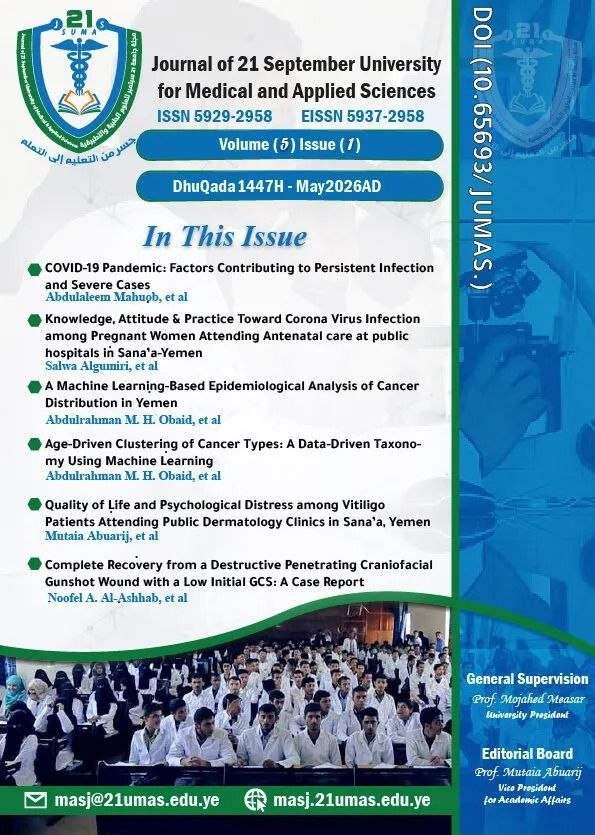
Age-Driven Clustering of Cancer Types: A Data-Driven Taxonomy Using Machine Learning
DOI:
https://doi.org/10.65693/j21umas.2026.v5i1.419الكلمات المفتاحية:
Age determinant, cancer distribution, machine learning, clustering, Gaussian Mixture Model.الملخص
Global mortality remains heavily driven by cancer, with patient age serving as a primary determinant of both incidence and pathological distribution. This study evaluates the predictive weight of age on cancer typology through an unsupervised machine learning lens, utilising a dataset of over 5,000 de-identified records from the National Oncology Centre in Yemen. The authors constructed a Python-based analytical framework to handle data preprocessing and imputation, subsequently comparing the efficacy of K-Means, Agglomerative Clustering, and Gaussian Mixture Modelling (GMM). GMM proved the most robust approach, yielding a Silhouette Score of 0.6135. Consequently, this model formed the basis for the final analysis. To ensure the clusters reflected genuine biological trends rather than stochastic noise, the authors validated the results using ANOVA and Chi-Squared tests. The analysis identified two distinct, age-stratified cohorts. The first, encompassing patients aged 2–40, showed a higher prevalence of bone marrow, lymphatic, thyroid, and breast malignancies. In contrast, the older cohort (ages 41–101) was characterised largely by breast and gastrointestinal cancers. These results establish age as a measurable, objective predictor of cancer distribution. Such findings suggest that clinical screening protocols and diagnostic priorities must be calibrated more closely to specific age demographics to enhance early detection efforts.
المراجع
1. Sung, H., et al. (2020). Global Cancer Statistics 2020: GLOBOCAN Estimates of Incidence and Mortality Worldwide for 36 Cancers in 185 Countries. CA: A Cancer Journal for Clinicians.
2. Smetana, K., Lacina, L., Szabo, P., Dvořánková, B., Brož, P., & Šedo, A. (2016). Ageing as an important risk factor for cancer. Anticancer research, 36(10), 5009-5017.
3. Terracina, S., Ferraguti, G., Petrella, C., Bruno, S. M., Blaconà, G., Di Certo, M. G., ... & Fiore, M. (2023). Characteristic hallmarks of aging and the impact on carcinogenesis. Current Cancer Drug Targets, 23(2), 87-102.
4. OWID. (September 16, 2024). Distribution of causes of death worldwide in 2021. In Statista. Retrieved March 26, 2025, from https://www.statista.com/statistics/1493203/share-of-deaths-worldwide-by-cause-2021/
5. Wu, Z., Xia, F., & Lin, R. (2024). Global burden of cancer and associated risk factors in 204 countries and territories, 1980-2021: a systematic analysis for the GBD 2021. Journal of hematology & oncology, 17(1), 119. https://doi.org/10.1186/s13045-024-01640-8
6. National Cancer Institute. (n.d.). Age and cancer risk. U.S. Department of Health and Human Services. https://www.cancer.gov/about-cancer/causes-prevention/risk/age
7. Woodman, R. J., & Mangoni, A. A. (2023). A comprehensive review of machine learning algorithms and their application in geriatric medicine: present and future. Aging Clinical and Experimental Research, 35(11), 2363-2397.
8. Ballard, J. L., Wang, Z., Li, W., Shen, L., & Long, Q. (2024). Deep learning-based approaches for multi-omics data integration and analysis. BioData Mining, 17(1), 38.
9. Gab Allah, A. M., Gaballa, M., Elshennawy, N. M., & Elkholy, A. (2025). Edge-supervised convolutional neural network for histopathological classification of oral cancer images. Neural Computing and Applications, 1-20.
10. Buyrukoğlu, G. (2024). Survival analysis in breast cancer: evaluating ensemble learning techniques for prediction. PeerJ Computer Science, 10, e2147.
11. Zolfaghari, B., Mirsadeghi, L., Bibak, K., & Kavousi, K. (2023). Cancer prognosis and diagnosis methods based on ensemble learning. ACM Computing Surveys, 55(12), 1-34.
12. de Carvalho, T. C., da Mota Borges, A. K., & da Silva, I. F. (2023). Stomach cancer incidence trends in selected Latin America countries: Age, period, and birth-cohort effects. Cancer Epidemiology, 85, 102392
13. Johnston, W. T., Erdmann, F., Newton, R., Steliarova-Foucher, E., Schüz, J., & Roman, E. (2021). Childhood cancer: Estimating regional and global incidence. Cancer epidemiology, 71, 101662.
14. Godoy-Casasbuenas, N., Rincón, C. J., Gil, F., Arias, N., Pérez, C. U., Yépez, M. C., & de Vries, E. (2024). Age-period-cohort effects on incidence trends of childhood leukemia from four population-based cancer registries in Colombia. Cancer Epidemiology, 89, 102548.
15. Greppin, K., Cioffi, G., Waite, K. A., Ostrom, Q. T., Landi, D., Takaoka, K., ... & Barnholtz-Sloan, J. S. (2022). Epidemiology of pineoblastoma in the United States, 2000–2017. Neuro-Oncology Practice, 9(2), 149-157.
16. Gheybi, K., Buckley, E., Vitry, A., & Roder, D. (2022). Occurrence of comorbidity with colorectal cancer and variations by age and stage at diagnosis. Cancer Epidemiology, 80, 102246.
Alsalit, G.M., Al-Wesabi, M.M. & Jowah, H.M. Drivers of perceived healthcare service quality among healthcare workers in TQM-implementing hospitals in conflict-affected yemen: a cross-sectional study. Confl Health (2026). https://doi.org/10.1186/s13031-026-00839-5
2. Shamlan, M. A. M., & Al-Wesabi, M. M. M. (2026, May 26). Clinical governance and healthcare quality in conflict-affected settings: A cross-sectional study of hospitals in Yemen [Preprint]. Research Square. https://doi.org/10.21203/rs.3.rs-9442217/v1
3. Qabban, K. A., Al-Wesabi, M. M., & Jowah, H. M. (2026). Association between Joint Commission International patient-centered standards and self-reported nursing performance in Sana′a, Yemen hospitals. Journal of Nursing Management, 2026, Article 8353270. https://doi.org/10.1155/jonm/8353270
4. Al-Wesabi, M.M., Measar, M.A. & Eskander, N.A. Combined impact of surgical lighting and flooring surface characteristics on staff stress: A hospital field study. Sci Rep (2026). https://doi.org/10.1038/s41598-026-70738-5
التنزيلات
منشور
إصدار
القسم
الرخصة
الحقوق الفكرية (c) 2026 Abdulrahman Obaid، Yousif Alhaj، Gameil Ali، Awadh Mohammed (المؤلف)

هذا العمل مرخص بموجب Creative Commons Attribution 4.0 International License.
تتبع هذه المجلة سياسة الوصول الحر (Open Access)، حيث تتوفر جميع محتوياتها مجاناً للمستخدمين والمؤسسات. يُسمح للقراء بتحميل الأبحاث، قراءتها، طباعتها، الاقتباس منها، أو البناء عليها، بشرط نَسب العمل إلى أصحابه الأصليين والإشارة إلى المجلة كمنصة للنشر. جميع المواد المنشورة تخضع لترخيص المشاع الإبداعي (نَسب المُصنَّف 4.0 دولي - CC BY 4.0).