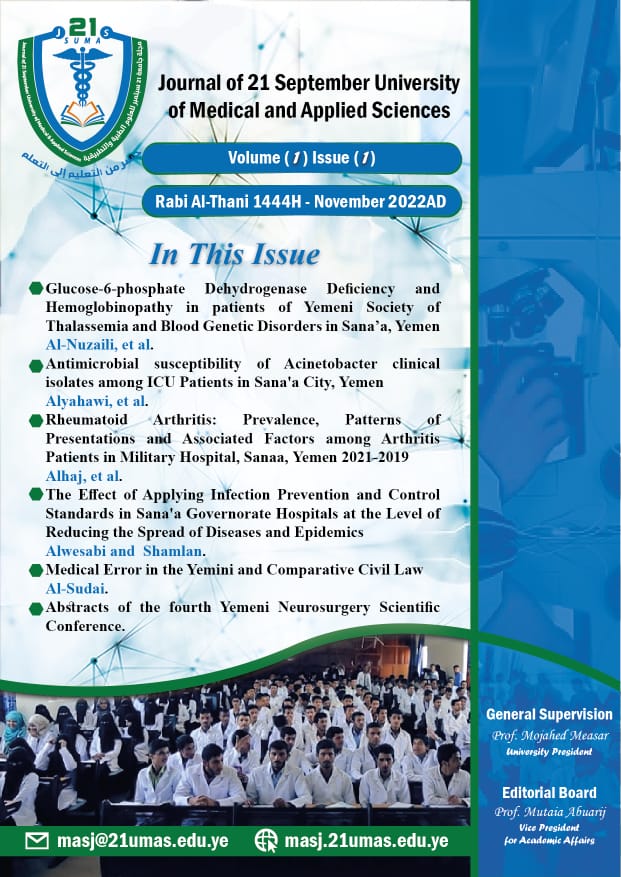
The Effect of Applying Infection Prevention and Control Standards in Sana'a Governorate Hospitals at the Level of Reducing the Spread of Diseases and Epidemics
DOI:
https://doi.org/10.65693/masj.2022.v1i1.17Keywords:
Infection Prevention and Control (IPC) standards, diseases and epidemics, Sana'a Governorate hospitals.Abstract
This study aimed to identify the level of commitment of Yemeni hospitals in Sana’a governorate in the application of infection prevention and control standards, and the extent of their impact on the level of disease outbreaks and epidemics in the governorate. To achieve the aim of the study, the descriptive approach was adopted with its both survey and analytical parts. In addition, the questionnaire tool, and assessment and observation tool for methods and means of infection control were used to obtain the study data. The study came to the conclusion that the hospitals of Sana’a governorate apply infection prevention and control standards merely to a medium degree. The risk and probability of disease and epidemic spread in the governorate was 39%, which is high in comparison with the global standard. The study also showed a statistically significant effect and an average positive correlation between the level of application of infection prevention and control standards and the level of limiting the spread of diseases and epidemics in the governorate. The study came out with a set of recommendations, the most important of which are: the necessity of adopting and developing procedural work guides (policies and procedures), by the Ministry of Health, to implement infection control programs, and activating the follow-up and strict control system that ensures the implementation of infection prevention and control standards efficiently and effectively by administrations and workers. It also recommended organizing training programs on the mechanism for the application of infection prevention and control standards and working to create job and living stability for workers as well.
References
1. السيروان، عبدالعزيز. (1986). المعجم الجامع لغريب مفردات القرآن الكريم. (الطبعة الأولى). دار العلم للملايين، بيروت، لبنان.
2. مجموعة البنك الدولي (2020). تقرير التصدي لجائحة كرونا (كوفيد-19). منظمة الصحة العالمية، تقرير رقم P173862، صنعاء، اليمن. http://www.worldbank.org/projects. 5/2/2021. 23:35
3. منظمة الصحة العالمية. (2021). الاستجابة الطارئة لمكافحة مسببات الأمراض المعدية شديدة الخطورة، المكتب الإقليمي للشرق الأوسط . . http://www.emro.who.int/press-releases/2021-arabic/emergency-response-in-yemen-who-and-the-government-of-japans-fight-against-high-threat-infectious-pathogens.html. 2/7/2021. 1:20
4. منظمة الصحة العالمية. (2020). وباء السل. https://www.who.int/ar/news-room/fact-sheets/detail/tuberculosis. 5/2/2021. 23:40
5. منظمة الصحة العالمية، (2020). الترصد والتنبؤ والاستجابة، المكتب الإقليمي للشرق الأوسط. http://www.emro.who.int/ar/surveillance-forecasting-response/about. 5/2/2021. 23:45/
6. منظمة الصحة العالمية، (2020). الترصد والتنبؤ والاستجابة، المكتب الإقليمي للشرق الأوسط. http://www.emro.who.int/ar/surveillance-forecasting-response/about. 6/2/2021. 1:15
7. وزارة الصحة العامة والسكان. (2019). الدليل التدريبي الوطني للوقاية من العدوى والسيطرة عليها. (الطبعة الأولى). وزارة الصحة العامة والسكان، صنعاء. اليمن.
8. اللجنة الفرنسية لمكافحة العدوى، (2019). مكافحة العدوى في المستشفيات، باريس، فرنسا. . 9/12/2020. 22:27 https://thearabhospital.com/features-ar/
9. منظمة الصحة العالمية. (2021). الكوليرا، المكتب الإقليمي للشرق الأوسط. https://www.who.int/ar/news-room/fact-sheets/detail/cholera. .9/6/2021. 23:10
10. منظمة الصحة العالمية. (2020). حمى الضنك وحمى الضنك الوخيمة، المكتب الإقليمي للشرق الأوسط. https://www.who.int/ar/news-room/fact-sheets/detail/dengue-and-severe-dengue. 5/2/2021. 23:30.
ثانيا: المصادر والمراجع الأجنبية:
1. ACSQHC. (2019). Australian Guidelines for the Prevention and Control of Infection in Healthcare. Commonwealth of Australia. Australian Government. Health and Medical Research Council Australia (NHMRC).
2. ACSQH. (2019). Action 3.1 | Australian Commission on Safety and Quality in HealthCare[ACSQH].Safetyandquality.Gov.Au. https://www.safetyandquality.gov.au/standards/nsqhs-standards/preventing-and-controlling-healthcare-associated-infection-standard/clinical-governance-and-quality-improvement-prevent-and-control-healthcare-associated-infections/action-31. 7/12/2020. 20:14.
3. Alrubaiee, G., Baharom, A., Faisal, I., Hayati, K. S., Mohd. Daud, S., & Basaleem, H. O. (2019). Randomized community trial on nosocomial infection control educational module for nurses in public hospitals in Yemen: A study protocol. BMC Nursing, 18(1), 10. https://doi.org/10.1186/s12912-019-0333-3. 7/12/2020. 21:30.
4. Awodele, O., Adewoye, A. A., & Oparah, A. C. (2016). Assessment of medical waste management in seven hospitals in Lagos, Nigeria. BMC Public Health, 16(1), 1–11.
5. Burki, T. (2021). Infectious diseases in Yemen Sleeping sickness in Ivory Coast. In Lancet Infect. Dis. (Infectious Diseases No. 5; Vol. 21, pp. 610–611). Elsevier Ltd. https://doi.org/10.1016/S1473-3099(21)00218-8. 17/7/2021. 22:15.
6. Cambridge English Dictionary. (2021). QUALITY IMPROVEMENT | meaning in the Cambridge English Dictionary. Cambridge English Dictionary. https://dictionary.cambridge.org/dictionary/english/quality-improvement?q=Quality+Improvement. 17/7/2021. 20:50.
7. CDC. (2018, December 17). Symptoms, Diagnosis, & Treatment | Chikungunya virus | CDC. https://www.cdc.gov/chikungunya/symptoms/index.html. 7/12/2020. 20:14.
8. CDC, C., Team, R., Jorden, M. A., Rudman, S. L., Villarino, E., Hoferka, S., Patel, M. T., Bemis, K., Simmons, C. R., & Jespersen, M. (2020). Evidence for limited early spread of COVID-19 within the United States, January–February (2020). Morbidity and Mortality Weekly Report, 69(22), 680.
9. CDC. (2021). Sharps injury prevention workbook |. https://www.premiersafetyinstitute.org/safety-topics-az/needlestick-prevention/cdc-sharps-injury-prevention-workbook/. 7/6/2021. 19:22.
10. Damani, N. (2012). Manual of Infection Prevention and Control (3 ed.). Geneva, Switzerland, New York: OXFORD UNIVERSITY press. doi:978–0–19–969835–6
11. Dancer, S. J. (2009). The role of environmental cleaning in the control of hospital-acquired infection. Journal of Hospital Infection, 73(4), 378–385. https://doi.org/10.1016/j.jhin.2009.03.030. 7/12/2020. 23:12.
12. Elseviers, M. M., Arias-Guillén, M., Gorke, A., & Arens, H.-J. (2014). SHARPS INJURIES AMONGST HEALTHCARE WORKERS: REVIEW OF INCIDENCE, TRANSMISSIONS AND COSTS. Journal of Renal Care, 1.
13. Halton, K., Hall, L., Gardner, A., MacBeth, D., & Mitchell, B. G. (2017). Exploring the context for effective clinical governance in infection control. American Journal of Infection Control, 45(3), 278–283.
14. Harding, E., Wait, S., & Scrutton, J. (2015). The state of play in person-centred care. London, UK: The Health Policy Partnership.
15. Infection Prevention and Control Team. (2016). Isolation Policy. Heart of England NHS Foundation Trust, Mercy Hospital, 5(September), 1–9.
16. Jang, Y.-C., Lee, C., Yoon, O.-S., & Kim, H. (2006). Medical waste management in Korea. Journal of Environmental Management, 80(2), 107–115.
17. Karahan, E., Taşdemir, N., & Çelik, S. (2019). Factors influrncing compliance wtih isolation precautions among nurses who work in Turkish surgical clinics.
18. Marshall, J. K., Thabane, M., Garg, A. X., Clark, W. F., Moayyedi, P., Collins, S. M., & Investigators, W. H. S. (2010). Eight-year prognosis of postinfectious irritable bowel syndrome following waterborne bacterial dysentery. Gut, 59(5), 605–611.
19. McColl, A. J., Roderick, P., & Gabbay, J. (1997). 1 Secretary of State for Health. The new NHS. London: Stationery Office, 1997. 2 NHS Executive. The new NHS, modern and dependable: a national framework for assessing performance. London: Department of Health, 1998. 3 Secretary of State for Health. Our healthier nation. London: Stationery. Institute for Health Research and Development, 167, 88.
20. Mirza, N., Reynolds, T., Coletta, M., Suda, K., Soyiri, I., Markle, A., Leopold, H., Lenert, L., Samoff, E., & Siniscalchi, A. (2013). Steps to a sustainable public health surveillance enterprise a commentary from the international society for disease surveillance. Online Journal of Public Health Informatics, 5(2), 210.
21. NHS. (2014). ASEPTIC NON - TOUCH TECHNIQUE (ANTT) Procedure ICPr014 (14th ed.). NHS foundation trust. http://www.nhsla.com/Pages/Home.aspx. 7/12/2020. 23:33.
22. OCDE. (2019). France: Country Health Profile 2019, State of Health in the EU. OECD Publ., 24.
23. Parush, A., Wacht, O., Gomes, R., & Frenkel, A. (2020). Human Factor Considerations in Using Personal Protective Equipment in the COVID-19 Pandemic Context: Binational Survey Study. Journal of Medical Internet Research, 22(6), e19947. https://doi.org/10.2196/19947. 10/3/2021. 22:19.
24. Patil, A. D., & Shekdar, A. V. (2001). Health-care waste management in India. Journal of Environmental Management, 63(2), 211–220.
25. Rosenthal, V. D., Guzman, S., & Safdar, N. (2005). Reduction in nosocomial infection with improved hand hygiene in intensive care units of a tertiary care hospital in Argentina. American Journal of Infection Control, 33(7), 392–397.
26. Rowley, S., & Clare, S. (2011). ANTT: A standard approach to aseptic technique. Nursing Times, 107(36) , 12.
27. Safety, O., & Administration, H. (2017). Healthcare Wide Hazards: Needlestick/Sharps Injuries.
28. Schneider, C. H., Sturmberg, J., Gillespie, J., Wilson, A., Lukersmith, S., & Salvador-Carulla, L. (2016). Applying complex adaptive system thinking to Australian health care: Expert commentary.
29. Shinee, E., Gombojav, E., Nishimura, A., Hamajima, N., & Ito, K. (2008). Healthcare waste management in the capital city of Mongolia. Waste Management, 28(2), 435–441.
30. Siegel, J. D., Rhinehart, E., Jackson, M., Chiarello, L., & Committee, H. C. I. C. P. A. (2007). guideline for isolation precautions: Preventing transmission of infectious agents in health care settings. American Journal of Infection Control, 35(10), 65–164.
31. WHO. (2009c). WHO guidelines on hand hygiene in health care (p. 216). World Health Organization. https://apps.who.int/iris/bitstream/handle/10665/44102/9789241597906_eng.pdf?sequence=1. 7/12/2020. 21:36.
32. WHO. (2019). CHOLERA PREVENTION AND CONTROL. https://www.who.int/ar/news-room/fact-sheets/detail/cholera. 7/12/2020. 22:31.
33. WHO. (2020f). Home/Newsroom/Fact sheets/Detail/Antibiotic resistance. https://www.who.int/ar/news-room/fact-sheets/detail/antibiotic-resistance. 13/4/2021. 20:15.
34. WHAIP, T. (2019). Infection Prevention Model, Policy/Procedure 5, Safe Management of Linen and laundry policy. Welsh Healthcare Associated Infections Sub-Group (WHAISG), January, 1–15..
35. Zimmerman, P.-A., Mason, M., & Elder, E. (2016). A healthy degree of suspicion: A discussion of the implementation of transmission-based precautions in the emergency department. Australasian Emergency Nursing Journal, 19(3), 149–152.
36. Medical Dictionary. (2009). Hand hygiene. TheFreeDictionary.Com. https://medical-dictionary.thefreedictionary.com/hand+hygiene. 15/12/2020. 23:21.
Downloads
Published
Data Availability Statement
yes
Issue
Section
License
Copyright (c) 2022 الدكتور منير مصلح الوصابي، أ. محمدأحمد شملان (المؤلف)

This work is licensed under a Creative Commons Attribution 4.0 International License.
This is an open-access journal which means that all content is freely available without charge to the user or their institution. Users are allowed to read, download, copy, distribute, print, search, or link to the full texts of the articles, or use them for any other lawful purpose, provided the original work is properly cited. All articles are licensed under a Creative Commons Attribution 4.0 International License (CC BY 4.0).