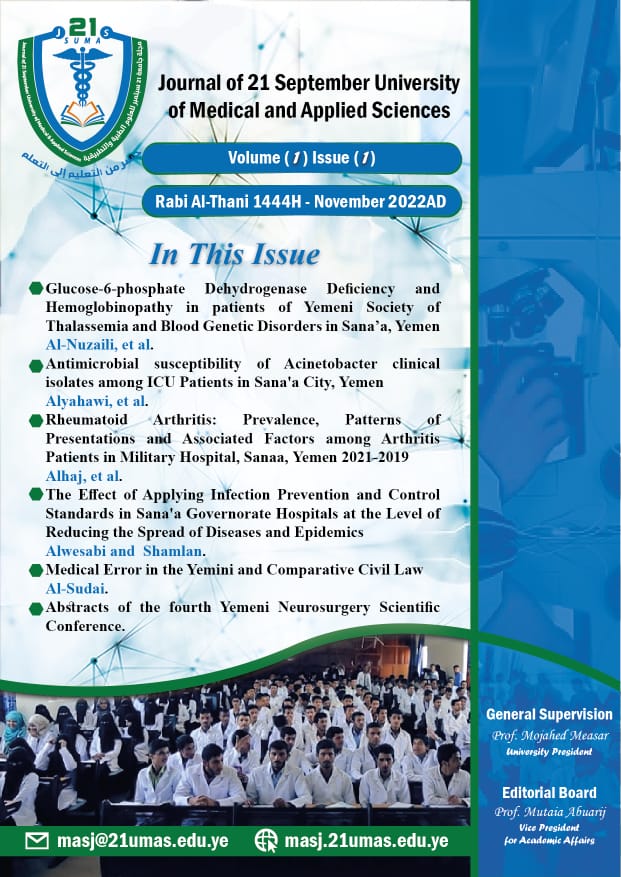
التهاب المفاصل الروماتويدي: معدل الانتشار، وأنماط المظاهر السريرية، والعوامل المرتبطة به بين مرضى التهاب المفاصل في المستشفى العسكري بصنعاء، اليمن 2019-2021م
DOI:
https://doi.org/10.65693/masj.2022.v1i1.15الكلمات المفتاحية:
التهاب المفاصل الروماتويدي، المظاهر السريرية، تفاقم المرض (الانتكاسات)، التهاب المفاصل، اليمنالملخص
خلفية الدراسة: يُعد التهاب المفاصل الروماتويدي (RA) مرضاً مناعياً ذاتياً جهازياً، يتميز بالتهاب المفاصل الالتهابي والمظاهر السريرية اللامفصلية (خارج نطاق المفاصل).
الهدف: هدفت هذه الدراسة إلى توصيف معدل انتشار التهاب المفاصل الروماتويدي والعوامل المرتبطة به بين مرضى التهاب المفاصل في المستشفى العسكري بمدينة صنعاء، اليمن.
المنهجية: أُجريت هذه الدراسة بوصفها دراسة حشدية مستقبلية قائمة على المنشأة الصحية (Prospective Cohort Study). ومن بين إجمالي 650 مريضاً تم تشخيصهم، جرى اختيار وتقييم مئة مريض يعانون من التهاب المفاصل الروماتويدي. جُمِعت البيانات باستخدام استبيان أعدّه وصاغه الباحثون، وحُلِّلت عبر برنامج الحزمة الإحصائية للعلوم الاجتماعية (SPSS) لمقارنة أنماط المظاهر السريرية لالتهاب المفاصل الروماتويدي وعلاقاتها بالخصائص الديموغرافية والسريرية.
النتائج: شملت الدراسة الحالية 650 مريضاً يعانون من التهاب المفاصل، ومن بين 200 حالة تم تشخيصها بالتهاب المفاصل الروماتويدي، كان 100 مريض فقط ممن أكملوا المتابعة الروتينية مؤهلين لإدراجهم في التحليل. شكلت الإناث نسبة 89% من العينة، وكانت الفئة العمرية الأكثر تكراراً هي (31-50 عاماً) بمتوسط عمر بلغ 40.5 ± 15.5 عاماً، كما كان 60% من المرضى من القاطنين في صنعاء. وتبين أن 5% فقط من المرضى لديهم تاريخ عائلي للإصابة بالمرض. وتمثلت الأمراض المصاحبة الأكثر ارتباطاً بالمرض في: ارتفاع ضغط الدم (HTN)، وداء السكري (DM)، والنقرس. وكانت نتائج الفحوصات إيجابية لعامل الروماتويد (RF) والأجسام المضادة للـ (Anti-CCP) بنسبة 57% و98% على التوالي. وأظهرت نتائج فحص تخطيط صدى القلب (Echo) أن 64% من المرضى لديهم نتائج طبيعية، في حين كان مرض القلب الناجم عن ارتفاع ضغط الدم (HHD) هو أكثر الأمراض المشخصة بالفحص يليه مرض القلب الروماتزمي (RHD). وبينت النتائج أن احتمالية إصابة الذكور المصابين بالتهاب المفاصل الروماتويدي بمرض مناعي ذاتي آخر تزيد عن أربعة أضعاف مقارنة بالإناث (OR = 4.87; CI:1.29-18.32; P = 0.011). وأظهرت غالبية الحالات التي عانت من تفاقم ونشاط المرض (Exacerbations) انخفاضاً حاداً ونقصاً في فيتامين د بنسبة (80%)، والتهاب المسالك البولية (UTI) بنسبة (40%)، ونقص كلس الدم بنسبة (30%).
الاستنتاج: خلصت الدراسة إلى أن التهاب المفاصل الروماتويدي يُعد أحد أكثر أمراض المناعة الذاتية شيوعاً بين مرضى التهاب المفاصل اليمنيين، وتعتبر الإناث في سن متوسطة هن الفئة الأكثر تضرراً به. ولوحظ وجود تلازم وتزامن بين التهاب المفاصل الروماتويدي وأمراض المناعة الذاتية الأخرى، لا سيما الذئبة الحمامية الممنهجة (SLE) وقصور الغدة الدرقية، حيث عانى معظم هؤلاء المرضى من نوبات تفاقم المرض ونشاطه. كما كان مرضا القلب الناجم عن ارتفاع ضغط الدم والقلب الروماتزمي هما الأكثر ظهوراً عند فحص وتخطيط صدى القلب. وأوصت الدراسة بضرورة توحيد بروتوكولات إدارة وعلاج حالات التهاب المفاصل الروماتويدي بناءً على الأدلة الإرشادية العالمية المحدثة لتقليل نوبات تفاقم المرض، ورفع مستوى الوعي لدى الأطباء والمرضى حول العوامل الرئيسية المؤدية لنشاط وتفاقم المرض.
المراجع
1. Alamanos Y, Drosos AA. Epidemiology of adult rheumatoid arthritis. Autoimmunity reviews. 2005;4(3):130-6.
2. Aletaha D, Neogi T, Silman AJ, Funovits J, Felson DT, Bingham III CO, et al. 2010 rheumatoid arthritis classification criteria: an American College of Rheumatology/European League Against Rheumatism collaborative initiative. Arthritis & rheumatism. 2010;62(9):2569-81.
3. Scott D, Pugner K, Kaarela K, Doyle D, Woolf A, Holmes J, et al. The links between joint damage and disability in rheumatoid arthritis. Rheumatology. 2000;39(2):122-32.
4. Tobón GJ, Youinou P, Saraux A. The environment, geo-epidemiology, and autoimmune disease: Rheumatoid arthritis. Autoimmunity reviews. 2010;9(5):A288-A92.
5. Kim K, Bang S-Y, Lee H-S, Cho S-K, Choi C-B, Sung Y-K, et al. High-density genotyping of immune loci in Koreans and Europeans identifies eight new rheumatoid arthritis risk loci. Annals of the rheumatic diseases. 2015;74(3):e13-e.
6. Yarwood A, Huizinga TW, Worthington J. The genetics of rheumatoid arthritis: risk and protection in different stages of the evolution of RA. Rheumatology. 2016;55(2):199-209.
7. Tracy A, Buckley CD, Raza K, editors. Pre-symptomatic autoimmunity in rheumatoid arthritis: when does the disease start? Seminars in immunopathology; 2017: Springer.
8. Jeffery LE, Raza K, Hewison M. Vitamin D in rheumatoid arthritis—towards clinical application. Nature Reviews Rheumatology. 2016;12(4):201-10.
9. Hunter TM, Boytsov NN, Zhang X, Schroeder K, Michaud K, Araujo AB. Prevalence of rheumatoid arthritis in the United States adult population in healthcare claims databases, 2004–2014. Rheumatology international. 2017;37(9):1551-7.
10. .Humphreys JH, Verstappen SM, Hyrich KL, Chipping JR, Marshall T, Symmons DP. The incidence of rheumatoid arthritis in the UK: comparisons using the 2010 ACR/EULAR classification criteria and the 1987 ACR classification criteria. Results from the Norfolk Arthritis Register. Annals of the rheumatic diseases. 2013;72(8):1315-20.
11. Lozano R, Naghavi M, Foreman K, Lim S, Shibuya K, Aboyans V, et al. Global and regional mortality from 235 causes of death for 20 age groups in 1990 and 2010: a systematic analysis for the Global Burden of Disease Study 2010. The lancet. 2012;380(9859):2095-128.
12. Cross M, Smith E, Hoy D, Carmona L, Wolfe F, Vos T, et al. The global burden of rheumatoid arthritis: estimates from the global burden of disease 2010 study. Annals of the rheumatic diseases. 2014;73(7):1316-22.
13. Callahan LF, Pincus T. Formal education level as a significant marker of clinical status in rheumatoid arthritis. Arthritis & Rheumatism: Official Journal of the American College of Rheumatology. 1988;31(11):1346-57.
14. Jiang X, Sandberg ME, Saevarsdottir S, Klareskog L, Alfredsson L, Bengtsson C. Higher education is associated with a better rheumatoid arthritis outcome concerning for pain and function but not disease activity: results from the EIRA cohort and Swedish rheumatology register. Arthritis research & therapy. 2015;17(1):1-9.
15. Jordan JM. Effect of race and ethnicity on outcomes in arthritis and rheumatic conditions. Current opinion in rheumatology. 1999;11(2):98-103.
16. Putrik P, Ramiro S, Keszei AP, Hmamouchi I, Dougados M, Uhlig T, et al. Lower education and living in countries with lower wealth are associated with higher disease activity in rheumatoid arthritis: results from the multinational COMORA study. Annals of the rheumatic diseases. 2016;75(3):540-6.
17. Badsha H, Kong KO, Tak PP. Rheumatoid arthritis in the united Arab Emirates. Clinical rheumatology. 2008;27(6):739-42.
18. Dargham SR, Zahirovic S, Hammoudeh M, Al Emadi S, Masri BK, Halabi H, et al. Epidemiology and treatment patterns of rheumatoid arthritis in a large cohort of Arab patients. PLoS One. 2018;13(12):e0208240.
19. El-Zorkany B, Mokbel A, Gamal SM, Mousa M, Youssef M, Hmamouchi I. Comparison of comorbidities of the Egyptian rheumatoid arthritis patients to the global cohort of the COMORA study: a post-hoc analysis. Clinical rheumatology. 2016;35(5):1153-9.
20. Halabi H, Alarfaj A, Alawneh K, Alballa S, Alsaeid K, Badsha H, et al. Challenges and opportunities in the early diagnosis and optimal management of rheumatoid arthritis in A frica and the M iddle E ast. International journal of rheumatic diseases. 2015;18(3):268-75.
21. Fraenkel L, Bathon JM, England BR, St. Clair EW, Arayssi T, Carandang K, et al. 2021 American College of Rheumatology guideline for the treatment of rheumatoid arthritis. Arthritis & Rheumatology. 2021.
22. Smolen JS, Landewé RB, Bijlsma JW, Burmester GR, Dougados M, Kerschbaumer A, et al. EULAR recommendations for the management of rheumatoid arthritis with synthetic and biological disease-modifying antirheumatic drugs: 2019 update. Annals of the rheumatic diseases. 2020;79(6):685-99.
23. Curtis JR, Singh JA. Use of biologics in rheumatoid arthritis: current and emerging paradigms of care. Clinical therapeutics. 2011;33(6):679-707.
24. Pisetsky DS, Ward MM. Advances in the treatment of inflammatory arthritis. Best Practice & Research Clinical Rheumatology. 2012;26(2):251-61.
25. Putrik P, Ramiro S, Kvien TK, Sokka T, Pavlova M, Uhlig T, et al. Inequities in access to biologic and synthetic DMARDs across 46 European countries. Annals of the rheumatic diseases. 2014;73(1):198-206.
26. Aviña-Zubieta J, Choi H, Sadatsafavi M. Risk of Cardiovascular Mortality in Patients with Rheumatoid Arthritis: A Meta-Analysis of Observational Studies. Arthritis & Rheumatology, 59, 1690-1697. 2008.
27. Avina-Zubieta JA, Thomas J, Sadatsafavi M, Lehman AJ, Lacaille D. Risk of incident cardiovascular events in patients with rheumatoid arthritis: a meta-analysis of observational studies. Annals of the rheumatic diseases. 2012;71(9):1524-9.
28. Pujades-Rodriguez M, Duyx B, Thomas SL, Stogiannis D, Rahman A, Smeeth L, et al. Rheumatoid arthritis and incidence of twelve initial presentations of cardiovascular disease: a population record-linkage cohort study in England. PloS one. 2016;11(3):e0151245.
29. Kang EH, Liao KP, Kim SC. Cardiovascular safety of biologics and JAK inhibitors in patients with rheumatoid arthritis. Current rheumatology reports. 2018;20(7):1-12.
30. Al-Haimi RM, Othman AM, Al-Shamahy HA, Al-Moyed KA, Al-Selwi AHA. Common Autoimmune Diseases among Yemeni Patients in Sana’a City, Yemen. Yemeni Journal for Medical Sciences. 2020;14(1):22-7.
31. Safiri S, Kolahi AA, Hoy D, Smith E, Bettampadi D, Mansournia MA, et al. Global, regional and national burden of rheumatoid arthritis 1990–2017: a systematic analysis of the Global Burden of Disease study 2017. Annals of the rheumatic diseases. 2019;78(11):1463-71.
32. Tuncer T, Gilgil E, Kaçar C, Kurtaiş Y, Kutlay Ş, Bütün B, et al. Prevalence of rheumatoid arthritis and spondyloarthritis in Turkey: A nationwide study. Archives of rheumatology. 2018;33(2):128.
33. Bechman K, Tweehuysen L, Garrood T, Scott DL, Cope AP, Galloway JB, et al. Flares in rheumatoid arthritis patients with low disease activity: predictability and association with worse clinical outcomes. The Journal of rheumatology. 2018;45(11):1515-21.
34. Firestein GS, McInnes IB. Immunopathogenesis of rheumatoid arthritis. Immunity. 2017;46(2):183-96.
35. Rodrigues P, Ferreira B, Fonseca T, Costa RQ, Cabral S, Pinto JL, et al. Subclinical ventricular dysfunction in rheumatoid arthritis. The International Journal of Cardiovascular Imaging. 2021;37(3):847-59.
36. Bawazir YM. Clinicodemographic Profiles of Rheumatoid Arthritis Patients from a Single Center in Saudi Arabia. Open access rheumatology: research and reviews. 2020;12:267.
37. England BR, Thiele GM, Anderson DR, Mikuls TR. Increased cardiovascular risk in rheumatoid arthritis: mechanisms and implications. BMJ. 2018;361:k1036-k.
38. Almoallim H, Al Saleh J, Badsha H, Ahmed HM, Habjoka S, Menassa JA, et al. A Review of the prevalence and unmet needs in the management of rheumatoid arthritis in Africa and the Middle East. Rheumatology and Therapy. 2021;8(1):1-16.
39. Symmons D, Mathers C, Pfleger B. The global burden of rheumatoid arthritis in the year 2000 global burden of disease. World Health Organ. 2015;18(4):1-30.
40. Bao YK, Weide LG, Ganesan VC, Jakhar I, McGill JB, Sahil S, et al. High prevalence of comorbid autoimmune diseases in adults with type 1 diabetes from the HealthFacts database. Journal of diabetes. 2019;11(4):273-9.
41. El Bakry SA, Fayez D, Morad CS, Abdel-Salam AM, Abdel-Salam Z, ElKabarity RH, et al. Ischemic heart disease and rheumatoid arthritis: Do inflammatory cytokines have a role? Cytokine. 2017;96:228-33.
42. Kett C, Flint J, Openshaw M, Raza K, Kumar K. Self‐management strategies used during flares of rheumatoid arthritis in an ethnically diverse population. Musculoskeletal Care. 2010;8(4):204-14.
43. Dehghan A, Rahimpour S, Soleymani-Salehabadi H, Owlia M. Role of vitamin D in flare ups of rheumatoid arthritis. Zeitschrift für Rheumatologie. 2014;73(5):461-4
التنزيلات
منشور
خطاب توفر البيانات
نعم
إصدار
القسم
الرخصة
الحقوق الفكرية (c) 2022 د. أكرم يحيى الحاج، د. اشجان الوزير، د. سماح عبدالرشيد عبدالحفيظ، د. محمد الظبياني (المؤلف)

هذا العمل مرخص بموجب Creative Commons Attribution 4.0 International License.
تتبع هذه المجلة سياسة الوصول الحر (Open Access)، حيث تتوفر جميع محتوياتها مجاناً للمستخدمين والمؤسسات. يُسمح للقراء بتحميل الأبحاث، قراءتها، طباعتها، الاقتباس منها، أو البناء عليها، بشرط نَسب العمل إلى أصحابه الأصليين والإشارة إلى المجلة كمنصة للنشر. جميع المواد المنشورة تخضع لترخيص المشاع الإبداعي (نَسب المُصنَّف 4.0 دولي - CC BY 4.0).