
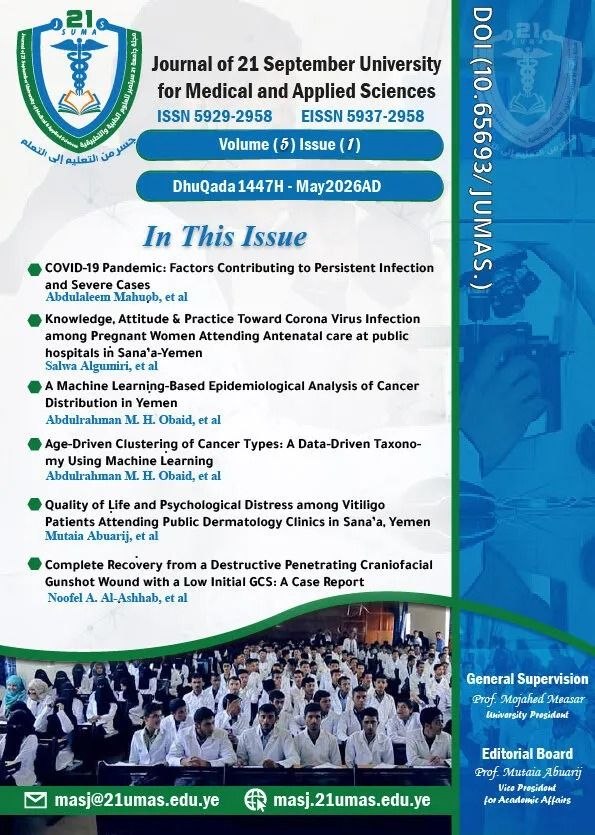
A Machine Learning-Based Epidemiological Analysis of Cancer Distribution in Yemen
DOI:
https://doi.org/10.65693/j21umas.2026.v5i1.370الكلمات المفتاحية:
Cancer epidemiology; Yemen; Machine learning; Random Forest; Cancer prevalence; Geographical distribution.الملخص
Cancer represents a severe public health crisis in Yemen. Current literature lacks the regional granularity required for effective policy. To bridge this gap, the authors parsed 5,226 clinical records from the National Oncology Centre, mapping the spatial and demographic dispersion of the disease across all governorates. After scrubbing raw data for inconsistencies, the authors deployed Random Forest classification and hierarchical clustering to quantify patient demographics, temporal shifts, and regional incidence rates. Cases cluster heavily in specific regions. Ibb, Taiz, and Dhamar alone account for over one-third of the total national caseload. Breast cancer is the primary diagnosis. Most patients fall within the middle-adulthood cohort. Hierarchical clustering partitioned the governorates into subgroups with shared oncological profiles, providing a framework for localized intervention. The machine learning models yielded a Top-1 accuracy of 0.192 and a Top-3 accuracy of 0.596. These metrics reflect the high diagnostic heterogeneity and the asymmetric distribution of cases inherent to the Yemeni landscape. This work establishes an empirical baseline for national cancer planning. These results enable evidence-based resource management and prevention programs tailored to regional epidemiological realities.
المراجع
1. Ajayi, R. O., & Ogunjobi, T. T. (2025). Environmental exposures and cancer risk: a comprehensive review. Medinformatics, 2(2), 80-92.
2. Setyawati, R., Astuti, A., Utami, T. P., Adiwijaya, S., & Hasyim, D. M. (2024). The importance of early detection in disease management. Journal of World Future Medicine, Health and Nursing, 2(1), 51-63.
3. Mansour, R., Abdel-Razeq, H., Al-Hussaini, M., Shamieh, O., Al-Ibraheem, A., Al-Omari, A., & Mansour, A. H. (2024). Systemic barriers to optimal cancer care in resource-limited countries: Jordanian healthcare as an example. Cancers, 16(6), 1117.
4. Arora, A., & Basu, N. (2023). Machine learning in modern healthcare. International Journal of Advanced Medical Sciences and Technology, 3(4), 12-18.
5. Wiratama, R. K. P., Cahyadi, E. S., Meshcherekov, D., & Purwitasari, D. (2024, June). Random forest based risk factor analysis for lung cancer prediction. In 2024 International Conference on Smart Computing, IoT and Machine Learning (SIML) (pp. 62-67). IEEE.
6. A. A. Bawazir, “Cancer incidence in Yemen from 1997 to 2011: A report from the Aden cancer registry,” BMC Cancer, vol. 18, p. 540, 2018.
7. M. A. Jawass et al., “Pattern of malignancies in children <15 years of age reported in the Hadhramout cancer registry, Yemen between 2002 and 2014,” Saudi Medical Journal, vol. 37, no. 5, pp. 513–520, 2016.
8. A. Ibrahim et al., “Cancer statistics in Yemen: Incidence and mortality, in 2020,” BMC Public Health, vol. 24, p. 962, 2024.
9. J. W. Bauer et al., “Geographic Information Systems and spatial analysis in cancer epidemiology,” Cancer Epidemiology, Biomarkers & Prevention, vol. 28, no. 3, pp. 333–339, 2019.
10. L. Gao, A. Datta, and S. Banerjee, “Spatial modeling for correlated cancers using bivariate directed graphs,” arXiv preprint arXiv:1911.11342, 2019.
11. Y. Wang, X. Chen, and F. Xue, “A review of Bayesian spatiotemporal models in spatial epidemiology,” ISPRS International Journal of Geo-Information, vol. 13, no. 3, p. 97, 2024.
12. F. Palmi-Perales et al., “Approximate Bayesian inference for multivariate point pattern analysis in disease mapping,” arXiv preprint arXiv:1903.11647, 2019.
13. N. Kianfar, B. Sartorius, C. L. Lau, R. Bergquist, and B. Kiani, “The future of spatial epidemiology in the AI era: Enhancing machine learning approaches with explicit spatial structure,” Geospatial Health, 2025.
14. R. K. McIntire et al., “Utilizing geospatial artificial intelligence to map cancer disparities across health regions: The iCAT tool,” International Journal of Environmental Research and Public Health, vol. 21, no. 4, 2024.
15. C. Liu and A. Mostafavi, “Decoding Urban-Health Nexus: Interpretable machine learning illuminates cancer prevalence based on intertwined city features,” arXiv preprint arXiv:2306.11847, 2023.
1. Al-Wesabi, M., & Shamlan, M. (2022). The Effect of Applying Infection Prevention and Control Standards in Sana’a Governorate Hospitals at the Level of Reducing the Spread of Diseases and Epidemics. Journal of 21 September University for Medical and Applied Sciences, 1(1). https://doi.org/10.65693/masj.2022.v1i1.17
2. Alyahawi, A., Al-Wesabi, M., & ALKaf, A. (2022). Antimicrobial susceptibility of Acinetobacter clinical isolates among ICU Patients in Sana’a City, Yemen. Journal of 21 September University for Medical and Applied Sciences, 1(1). https://doi.org/10.65693/masj.2022.v1i1.14
3. Alyahawi A, Measar M, Alwesabi M, Alkaf A. (2024). Clinically Significant Statin-Drug Interactions in Older Patients with Chronic Diseases. Pharmaceutical Research - Recent Advances and Trends Vol. 4, B P International, pp.1-21. https://doi.org/10.9734/bpi/prrat/v4/598
4. Al-Wesabi, M. (2020). The reality of the Yemeni health sector and the role of September 21 University for Medical and Applied Sciences in reforming it and building the modern Yemeni state (M. Dael, Trans.). Institutional Repository for Scientific Scholarship at 21 September University for Medical and Applied Sciences, 1(1), 106-133. https://doi.org/10.65693/irss.2020.v1i1.47
5. Shamlan, M. A. M., & Al-Wesabi, M. M. M. (2026, May 26). Clinical governance and healthcare quality in conflict-affected settings: A cross-sectional study of hospitals in Yemen [Preprint]. Research Square. https://doi.org/10.21203/rs.3.rs-9442217/v1
6. Qabban, K. A., Al-Wesabi, M. M. (2025). The Impact of Career Development on Improving Nursing Performance in Yemen Hospitals - Sana’a. Sana’a University Journal of Human Sciences, 4(11), 277-317. https://doi.org/10.59628/jhs.v4i11.1809
16. Qabban, K. A., Al-Wesabi, M. M., & Jowah, H. M. (2026). Association between Joint Commission International patient-centered standards and self-reported nursing performance in Sana′a, Yemen hospitals. Journal of Nursing Management, 2026, Article 8353270. https://doi.org/10.1155/jonm/8353270
Me’asar, M., Al-Hoothi, E., Shamsaldin, M., & Al-Shahethi, A. (2025). Clinical Presentation Variants of Chronic Subdural Hematoma Cases. Journal of 21 September University for Medical and Applied Sciences, 4(1). https://doi.org/10.65693/j21umas.2025.v4i1.217
Al-Akhali, K., & Alyahawi, A. (2025). The Role of Clinical Pharmacists in the Detection and Evaluation of Adverse Drug Events: A Review Article. Journal of 21 September University for Medical and Applied Sciences, 4(1). https://doi.org/10.65693/j21umas.2025.v4i1.220
Shamsaldin, M., Mojahed Me'asar, M. M., Ghanem, A., & Al-Aswadi, A. (2025). Epidemiological Description of Primary Brain Tumors: A Single-Center Retrospective Study of 75 Cases, Yemen. Journal of 21 September University for Medical and Applied Sciences, 4(1). https://doi.org/10.65693/j21umas.2025.v4i1.218
Abuarij, M., & Al-Agbari, A. (2024). Epidemiological Situation of Mucocutaneous Leishmaniasis in Yemen: A Descriptive Study in the Period from January 2017 to December 2022. Journal of 21 September University for Medical and Applied Sciences, 3(1), 1-11. https://doi.org/10.65693/j21umas.2024.v3i1.200
Abuarij, M., & Al Qtwani, A. (2023). Efficacy of Oral Isotretinoin in Combination with Desloratadine in the Treatment of Acne Vulgaris at Al-Thawrah General Hospital, Sana’a, Yemen . Journal of 21 September University for Medical and Applied Sciences, 2(1), 17-30. https://doi.org/10.65693/masj.2023.v2i1.23
التنزيلات
منشور
إصدار
القسم
الرخصة
الحقوق الفكرية (c) 2026 Abdulrahman M. H. Obaid، Gameil Ali، Yousif Alhaj، Awadh Ali Abdo Mohammed Awadh Ali Abdo Mohammed (المؤلف)

هذا العمل مرخص بموجب Creative Commons Attribution 4.0 International License.
تتبع هذه المجلة سياسة الوصول الحر (Open Access)، حيث تتوفر جميع محتوياتها مجاناً للمستخدمين والمؤسسات. يُسمح للقراء بتحميل الأبحاث، قراءتها، طباعتها، الاقتباس منها، أو البناء عليها، بشرط نَسب العمل إلى أصحابه الأصليين والإشارة إلى المجلة كمنصة للنشر. جميع المواد المنشورة تخضع لترخيص المشاع الإبداعي (نَسب المُصنَّف 4.0 دولي - CC BY 4.0).